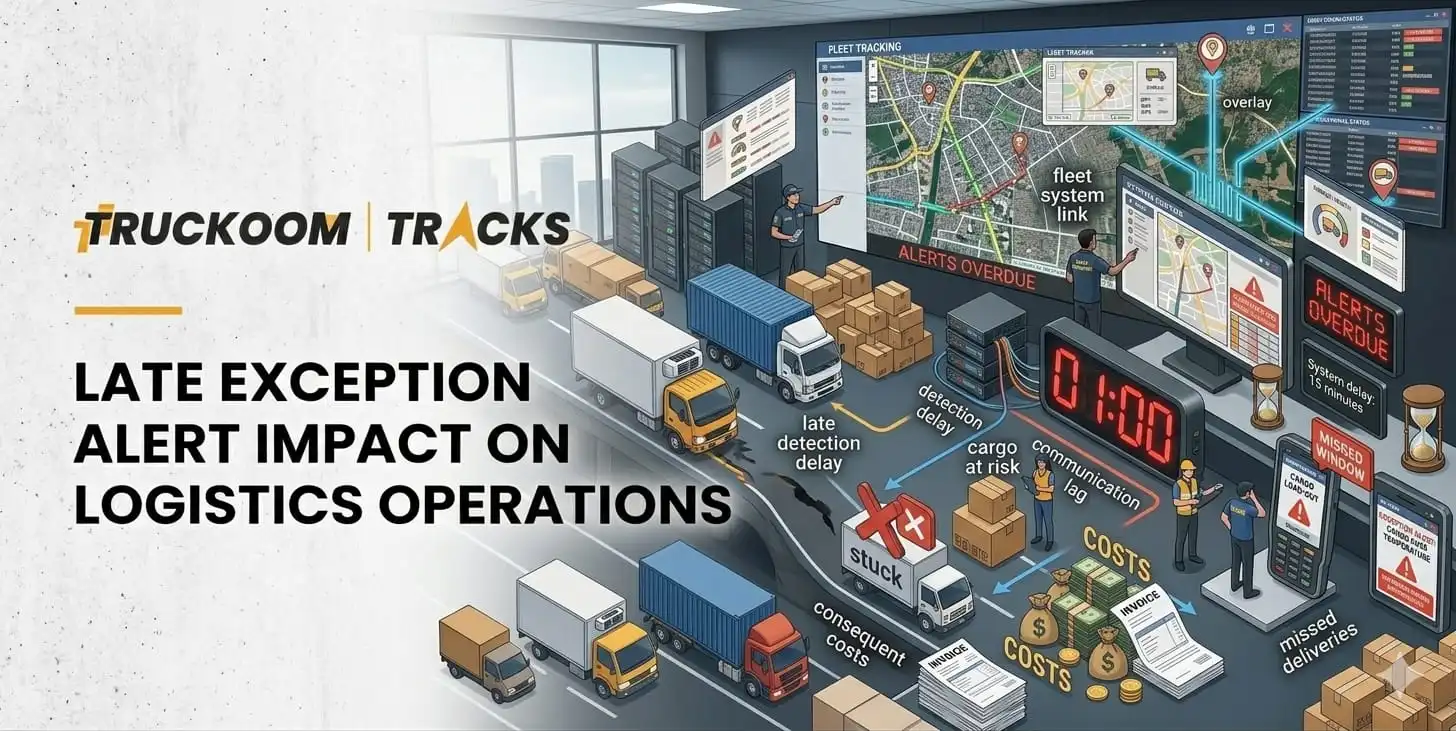

Late exception alerts turn small disruptions into expensive failures. Here is how they impact costs, service levels, and compliance, and how real-time monitoring helps logistics teams stay ahead.
Key takeaways
- Late alerts increase costs through emergency dispatch, missed delivery windows, spoilage, and penalties.
- Customers lose trust when issues are discovered too late to communicate proactively.
- Fleet utilization suffers when dispatch cannot reroute drivers and assets in time.
- Compliance risk rises when temperature excursions and route deviations are documented after the fact.
- Real-time exception monitoring, not just GPS tracking, is the operational standard.
What are “exception alerts” in logistics?
Exception alerts notify teams when something deviates from the plan, such as a delay, breakdown, route deviation, temperature excursion, detention, or hours-of-service risk. The faster the alert arrives, the more options dispatch has.
1) How late exception alerts create a domino effect
When a system reports an issue hours after it happens, the operation loses the window to use the best, lowest-cost fix.
A common example is a breakdown on a perishable load. With immediate visibility, dispatch can source a nearby rescue unit, arrange a transfer, and protect the delivery window. With a delayed alert, the only available capacity may be farther away, and the delivery window is already missed.
Typical costs that stack up quickly
- Emergency recovery and expedited handling
- Spoilage or cargo damage
- Late delivery penalties and service failure charges
- Extra admin time coordinating last-minute changes
2) Customer trust erodes faster than expected
Modern shippers expect real-time visibility. When clients learn about a delay before the carrier does, confidence drops.
Proactive communication changes the story from:
- “Why is my freight late?”
- “We identified the issue and here is the mitigation plan.”
That shift can protect relationships even when disruptions happen.
3) Hidden waste in driver and asset utilization
Late alerts create “blind time” where teams cannot optimize:
- Reroutes around congestion or closures
- Load swaps and recovery planning
- Detention responses at docks
- Dynamic rescheduling to keep equipment productive
Idle time becomes expensive time. In many operations, utilization losses are a bigger long-term cost than individual penalties.
4) Compliance and documentation risks (especially for regulated freight)
For food, pharma, and hazmat moves, exceptions require quick action and clear documentation. Late alerts can mean teams try to reconstruct events after the fact, which increases audit risk.
Real-time exception monitoring creates a stronger audit trail with timestamped alerts and logged actions.
5) The technology gap: tracking is not the same as exception monitoring
A vehicle dot on a map is not enough.
Basic tracking shows location.
Real-time exception monitoring detects and prioritizes risk, for example:
- A delay that will cause a missed appointment
- A deviation that triggers contract or compliance exposure
- A temperature excursion that requires corrective action
- A driver nearing an hours-of-service limit
The value comes from context and automation, not only GPS.
Estimating the real cost of late exception alerts
Many teams count only visible costs like penalties and emergency dispatch. For a more accurate view, include:
- Opportunity cost from suboptimal routing decisions
- Dispatcher and operations overhead spent “firefighting”
- Driver morale impact from constant reactive changes
- Customer churn and revenue loss from service failures
Moving toward real-time operations
A practical path is to start where disruption is most expensive:
- Highest-value customers
- Time-critical lanes
- Temperature-controlled freight
- Multi-stop routes where exceptions cascade
Then expand coverage once metrics prove return on investment.
Conclusion
Late exception alerts convert manageable events into major service and cost problems. For modern logistics operations, real-time exception monitoring is not an upgrade. It is the foundation for proactive service, higher utilization, and lower risk.